Achilles Tendinopathy
Treatment.
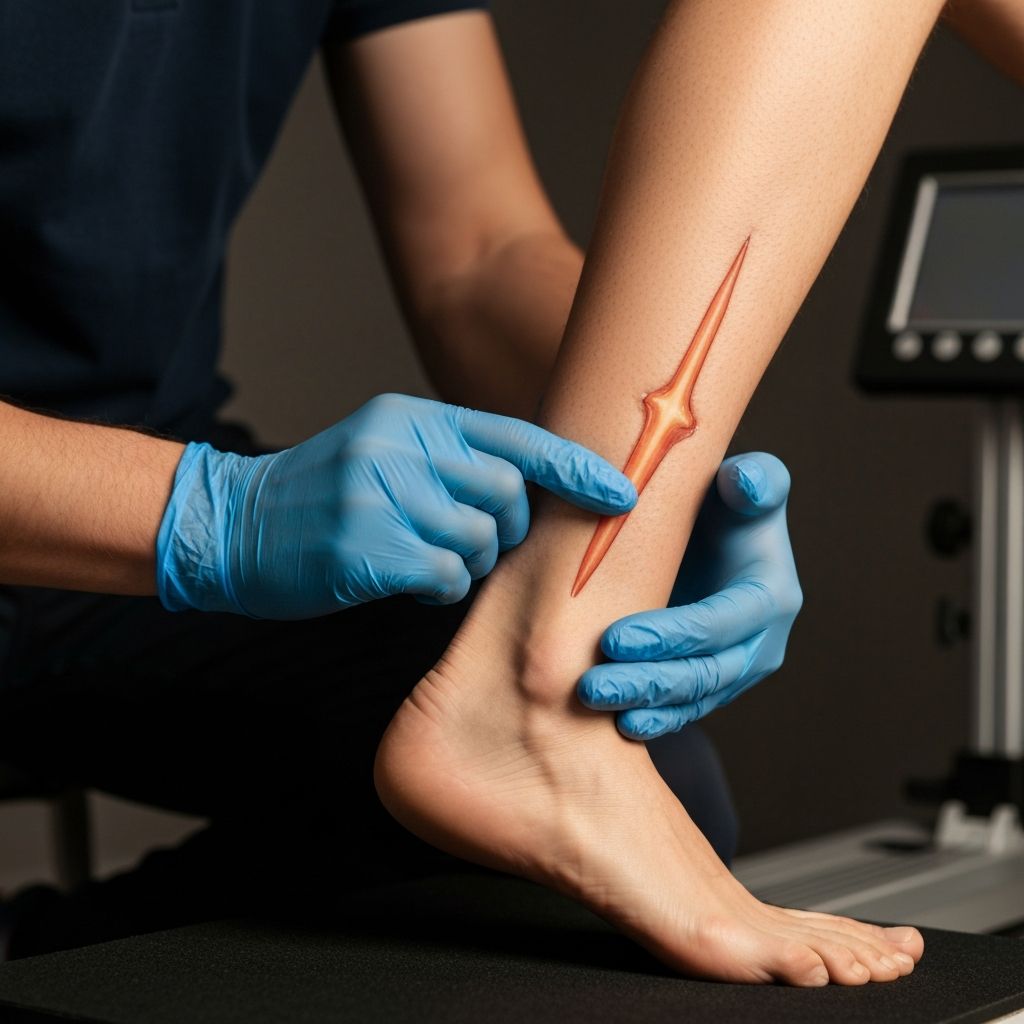
Achilles tendinopathy causes pain, stiffness and thickening at the back of the heel — affecting runners, athletes and anyone with overpronation, tight calves or training overload.
Our expert podiatrists treat Achilles tendinopathy with biomechanical assessment, eccentric strengthening programmes, custom orthotics and shockwave therapy — addressing the root cause, not just the symptoms.
Searching for: Achilles tendon pain • Achilles tendonitis treatment • heel cord pain • sore Achilles • Achilles pain when running • tight Achilles tendon • Achilles tendon thickening • calf tendon pain • back of heel pain • Achilles pain relief • how to treat Achilles tendonitis • why does my Achilles hurt • Achilles tendon treatment near me
Common Achilles Tendinopathy Symptoms
Achilles tendinopathy causes pain, stiffness and weakness at the back of the heel — especially in runners, athletes and people with overpronation.
Pain at the back of the heel
Achilles tendinopathy causes pain 2–6 cm above the heel insertion, often worse with activity and in the morning.
Morning stiffness & tightness
Achilles stiffness and pain are typically worst in the morning or after rest — improving with gentle movement but worsening with prolonged activity.
Tendon thickening or nodules
Chronic Achilles tendinopathy causes tendon thickening, visible swelling or palpable nodules — a sign of degenerative tendon changes.
Calf weakness & fatigue
Achilles pain reduces calf strength and power — making it difficult to push off, run, jump or walk uphill.
Pain when running or jumping
Achilles tendinopathy is aggravated by high-impact activities like running, jumping, hill sprints or plyometrics.
Pain climbing stairs or hills
Activities requiring calf push-off (stairs, hills, cycling) load the Achilles tendon and trigger pain.
Why Does Achilles Tendinopathy Happen?
Achilles tendinopathy is caused by overload, biomechanical faults and tendon degeneration — not just overuse.
Training overload or sudden increase
Achilles tendinopathy is most commonly caused by doing too much too soon — rapid increases in running mileage, speed work, hill training or jumping volume exceed the tendon's capacity to adapt.
Overpronation & flat feet
Excessive foot pronation (flat feet, arch collapse) increases inward rotation of the tibia, placing torsional stress on the Achilles tendon and increasing injury risk.
Tight or weak calf muscles
Tight gastrocnemius or soleus muscles increase tensile load on the Achilles tendon. Weak calves reduce shock absorption and force the tendon to work harder.
Age-related degeneration
Achilles tendon degeneration increases with age (35+) — reduced blood supply, collagen breakdown and loss of tendon elasticity make injury more likely.
Poor footwear or heel drop change
Running shoes with inadequate cushioning, worn-out midsoles or sudden changes in heel drop (high to low) increase Achilles stress.
Hard surfaces or uphill running
Running on concrete, tarmac or steep hills increases ground reaction forces and eccentric loading on the Achilles tendon.
Previous Achilles injury
A history of Achilles pain, partial tear or tendinopathy increases the risk of recurrence — especially if the tendon wasn't fully rehabilitated.
Ankle stiffness or limited dorsiflexion
Reduced ankle dorsiflexion (inability to bring toes toward shin) forces the Achilles to stretch excessively during gait, increasing strain.
Your Achilles Tendinopathy Assessment
We conduct a comprehensive biomechanical assessment to diagnose the root cause of your Achilles pain — not just treat the symptoms.
Clinical History & Pain Assessment
We start by understanding your pain — when it started, what makes it worse, your activity level, training history and any previous Achilles injuries. This helps us identify the root cause.
Detailed pain historyAchilles Tendon Palpation & Structure Assessment
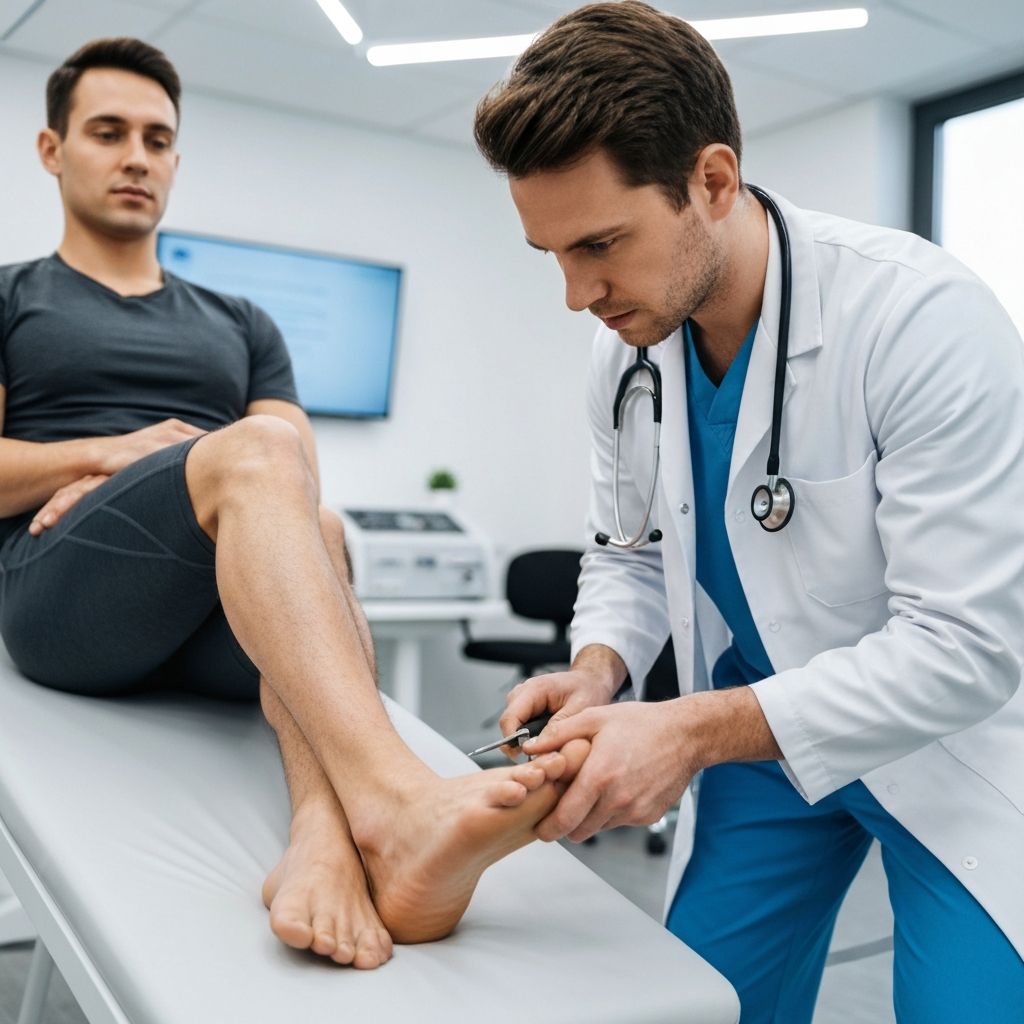
We palpate the Achilles tendon to identify areas of tenderness, thickening, nodules or crepitus (crackling). We assess tendon thickness, insertional vs mid-portion involvement and signs of degeneration.
Tendon structure examinationCalf Strength & Functional Testing
We test calf strength with single-leg heel raises, hopping and eccentric calf lowering. Weakness, pain or asymmetry indicate Achilles dysfunction.
Strength & function testsAnkle Range of Motion & Dorsiflexion
We measure ankle dorsiflexion (toes-to-shin movement) using the weight-bearing lunge test. Limited dorsiflexion increases Achilles strain and is a key risk factor for tendinopathy.
Ankle mobility assessmentBiomechanical Assessment & Gait Analysis
We assess your gait, foot posture, pronation pattern and lower limb alignment. Overpronation, flat feet, leg length discrepancy or poor running mechanics contribute to Achilles overload.
Gait & biomechanicsPressure Mapping & Podoscope Analysis
We use a podoscope or pressure plate to visualize foot pressure distribution and pronation. This identifies biomechanical faults causing Achilles stress.
Visual pressure analysisFootwear & Training Load Review
We assess your footwear — checking heel drop, cushioning, stability and wear patterns. We review your training volume, intensity and progression to identify overload.
Footwear & training auditDiagnosis & Severity Grading
Based on your assessment, we diagnose the type of Achilles tendinopathy (insertional vs mid-portion), grade severity (reactive, dysrepair or degenerative) and create a treatment plan.
Evidence-based diagnosisEvidence-Based Treatment Plan
We combine eccentric strengthening (the gold-standard), biomechanical correction and load management to rebuild tendon strength and resolve pain.
Load Management & Activity Modification
We reduce Achilles load by modifying or temporarily stopping aggravating activities (running, jumping, hill walking) and replacing them with low-impact alternatives (swimming, cycling, elliptical).
Eccentric Strengthening Programme (Alfredson Protocol)
The gold-standard treatment for Achilles tendinopathy is eccentric calf lowering exercises — 3 sets of 15 reps, twice daily, for 12 weeks. This rebuilds tendon structure and strength.
Calf Stretching & Flexibility Work
We prescribe targeted stretches for the gastrocnemius and soleus muscles to reduce Achilles tension and improve ankle dorsiflexion.
Custom Orthotics for Overpronation
If overpronation or flat feet are contributing to Achilles stress, we prescribe custom orthotics to control pronation, reduce tibial rotation and offload the Achilles tendon.
Footwear Prescription & Heel Lift
We recommend supportive footwear with adequate cushioning and heel drop. A temporary heel lift (5–10mm) can reduce Achilles strain during the acute phase.
Shockwave Therapy (If Indicated)
For chronic or degenerative Achilles tendinopathy, we may recommend shockwave therapy to stimulate tendon healing, break down scar tissue and reduce pain.
Gradual Return-to-Running Programme
Once pain and strength have improved, we guide you through a structured return-to-running plan — gradually increasing distance, intensity and frequency to prevent re-injury.
Why Choose General Foot Care for Achilles Tendinopathy?
HCPC-registered podiatrists with specialist training in sports biomechanics, tendinopathy and running injuries.
Comprehensive biomechanical assessment — gait analysis, pressure mapping and functional testing to identify the root cause.
Evidence-based eccentric strengthening programmes — the gold-standard treatment for Achilles tendinopathy.
Custom orthotics & footwear prescription — if overpronation or biomechanical faults are contributing to Achilles stress.
Shockwave therapy available for chronic or degenerative Achilles tendinopathy that hasn't responded to conservative treatment.
Related Services
Achilles tendinopathy often overlaps with other biomechanical issues. We can help with:
Serving Achilles Tendinopathy Patients Across Nottinghamshire
Our clinic is in Arnold, Nottingham. We provide expert Achilles tendinopathy treatment for patients across:
FAQs
Frequently Asked Questions
Achilles tendinopathy is a painful condition affecting the Achilles tendon — the large tendon connecting your calf muscles to your heel bone. It's caused by overload, repetitive stress or degeneration, leading to pain, stiffness, thickening and reduced tendon strength. Tendinopathy is different from tendonitis (acute inflammation) — it involves structural tendon degeneration and requires a different treatment approach.
Achilles tendinopathy is most commonly caused by training overload — doing too much too soon (rapid increases in running mileage, speed work, hills or jumping). Other causes include overpronation (flat feet), tight or weak calf muscles, poor footwear, hard running surfaces, age-related degeneration (35+), limited ankle mobility and previous Achilles injuries.
Symptoms include: pain at the back of the heel (2–6 cm above the heel insertion), morning stiffness that improves with movement, pain when running, jumping or climbing stairs, tendon thickening or nodules, calf weakness, and pain that worsens with increased activity. Achilles pain is typically gradual-onset (not sudden) and progressively worsens without treatment.
Achilles tendinopathy is treated with: load management (reducing or stopping aggravating activities), eccentric calf strengthening exercises (Alfredson protocol — 3 sets of 15 reps, twice daily for 12 weeks), calf stretching, custom orthotics (if overpronation is a factor), supportive footwear or heel lifts, and shockwave therapy for chronic cases. Recovery typically takes 3–6 months.
Achilles tendinopathy rarely heals without treatment — it's a degenerative condition that worsens with continued loading. Rest alone doesn't work because the tendon needs controlled loading (eccentric exercises) to rebuild strength and structure. Without treatment, tendinopathy can progress to chronic pain, tendon rupture or permanent weakness.
It depends on severity. Mild cases may allow reduced running volume or intensity while you rehab. Moderate-to-severe cases require a temporary break from running (4–12 weeks) to allow tendon healing. We replace running with low-impact cross-training (swimming, cycling, elliptical) to maintain fitness. Pushing through severe Achilles pain risks tendon rupture.
Achilles tendinopathy typically takes 3–6 months to fully heal with consistent eccentric strengthening, load management and biomechanical correction. Early-stage (reactive) tendinopathy may resolve in 6–12 weeks. Chronic or degenerative tendinopathy can take 6–12 months. Compliance with eccentric exercises is the most important factor in recovery time.
Mid-portion Achilles tendinopathy affects the middle third of the tendon (2–6 cm above the heel). It's more common in runners and responds well to eccentric exercises. Insertional Achilles tendinopathy affects the tendon where it attaches to the heel bone — often associated with heel spurs, calcification or bursitis. Insertional tendinopathy is more challenging to treat and may require modified exercises or shockwave therapy.
Yes, if overpronation (flat feet, excessive inward rolling) is contributing to Achilles stress. Custom orthotics control pronation, reduce tibial rotation and offload the Achilles tendon. Orthotics work best when combined with eccentric strengthening and load management. If your biomechanics are normal, orthotics may not be necessary.
Yes. Chronic, untreated Achilles tendinopathy weakens the tendon and increases the risk of partial or complete rupture — especially if you continue high-impact activities. Ruptures are most common in 30–50 year olds with a history of Achilles pain. Early diagnosis and treatment significantly reduce rupture risk.
Ice can help reduce pain and inflammation during the acute phase (first 1–2 weeks). After the acute phase, heat (warm towel, heat pack) may help before stretching or eccentric exercises. However, ice and heat are symptom management — they don't treat the underlying tendon degeneration. Eccentric strengthening is the most important treatment.
Our clinic is in Arnold, Nottingham. We treat Achilles tendinopathy for patients across Nottinghamshire including Gedling, Carlton, Mapperley, Woodthorpe, Ravenshead, Hucknall, Daybrook, Bestwood, Calverton, Lambley, Burton Joyce, West Bridgford, Beeston, Bingham, Radcliffe-on-Trent, Mansfield, Newark, Retford, Worksop and surrounding areas.
Ready to Walk Without Limits?
Book an appointment at our Arnold, Nottingham clinic today. Same-day appointments often available.